
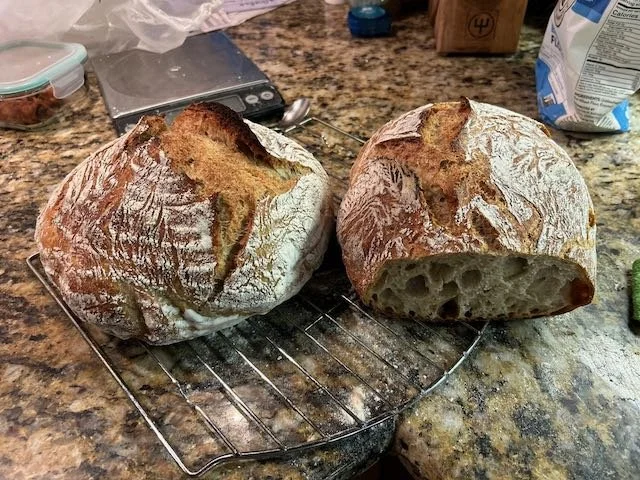
My Everyday Utilitarian Bread (Bread Flour/Whole Wheat Flour/Rye Flour)
This is my go to loaf when we just need bread in the pantry!
RECIPE
Makes 2 loaves
Feed the Starter (around 10:30 am)
If the starter has not been fed in a while pull it out of the fridge in the morning and let it sit for a couple of hours before feeding
Starter 50g
AP Flour 150 g
Water 150 g (around 84 degrees)
Mix all the ingredients in a 4 qt BPA plastic tub (or a medium sized tupperware or bowl that you can cover)
Allow to rise until it is about doubled to tripled in size
You’ll know it is done when a bit of the starter floats in water
You can discard the remaining starter
Mix the Bread (makes 2 loaves)
Bread Flour 805g (see the weight to volume conversion table if you don’t have a scale)
Whole Wheat Flour 160g
Rye Flour 120g
Water 670g (@ around 89-92 degrees, depending on how warm your house is)
Salt 24g
Starter 150g
Autolyse (around 7:00 pm)
In a 6 quart tub (or LARGE bowl or tupperware), mix flours and water together until all dry flour is incorporated and let sit, covered, for 30-45 minutes. COVER!
Mix (around 7:30 pm)
Add salt and starter to autolysed mixture.
A great way to weigh the starter is to add it to a bowl of water on a scale (which has been zeroed out). You’ll know the starter is ready when it floats.
Put remaining starter in mason jar, cover and put back in fridge
Using your hands mix the dough by alternating squeezing the dough between your fingers and thumb and folding the dough. Do this 3 times until your are left with a fully mixed dough (it won’t look smooth and that is ok). COVER.
Fold the dough 3 times a half hour apart.
Cover and let sit over night.
Shape (around 7:30 am or when it has increased by 2x to 2.5x size in volume)
Place dutch ovens in oven and preheat to 475 degrees. The dough should have almost doubled to 2.5x in size.
Gently dump the dough onto a heavily floured surface. This is a wet dough so it will be quite sticky. Flouring your hands helps as well.
Split the dough in half (it helps to put a line of flour where you plan on splitting the dough)
Place shaped dough (seam side down) in a floured proofing basket. You can also use a bowl with a heavily floured towel in it (otherwise it will stick when you try and dump it out). Place in a plastic bag.
Let proof for 30-50 minutes. You’ll know it’s ready when you gently press dough and it springs back slowly.
Bake (around 8-8:30 am)
Dump proofed dough onto a sheet of parchment paper (the seam side will be up now).
Remove dutch oven from oven and uncover
Place dough in dutch oven, cover and put back in oven
Bake covered for 24 minutes and uncovered for approximately 25 minutes (the outer crust will have a nice brown color).
Remove from oven and dump out onto a cooling rack
Allow to cool before eating, unless you plan on eating a full loaf right then.